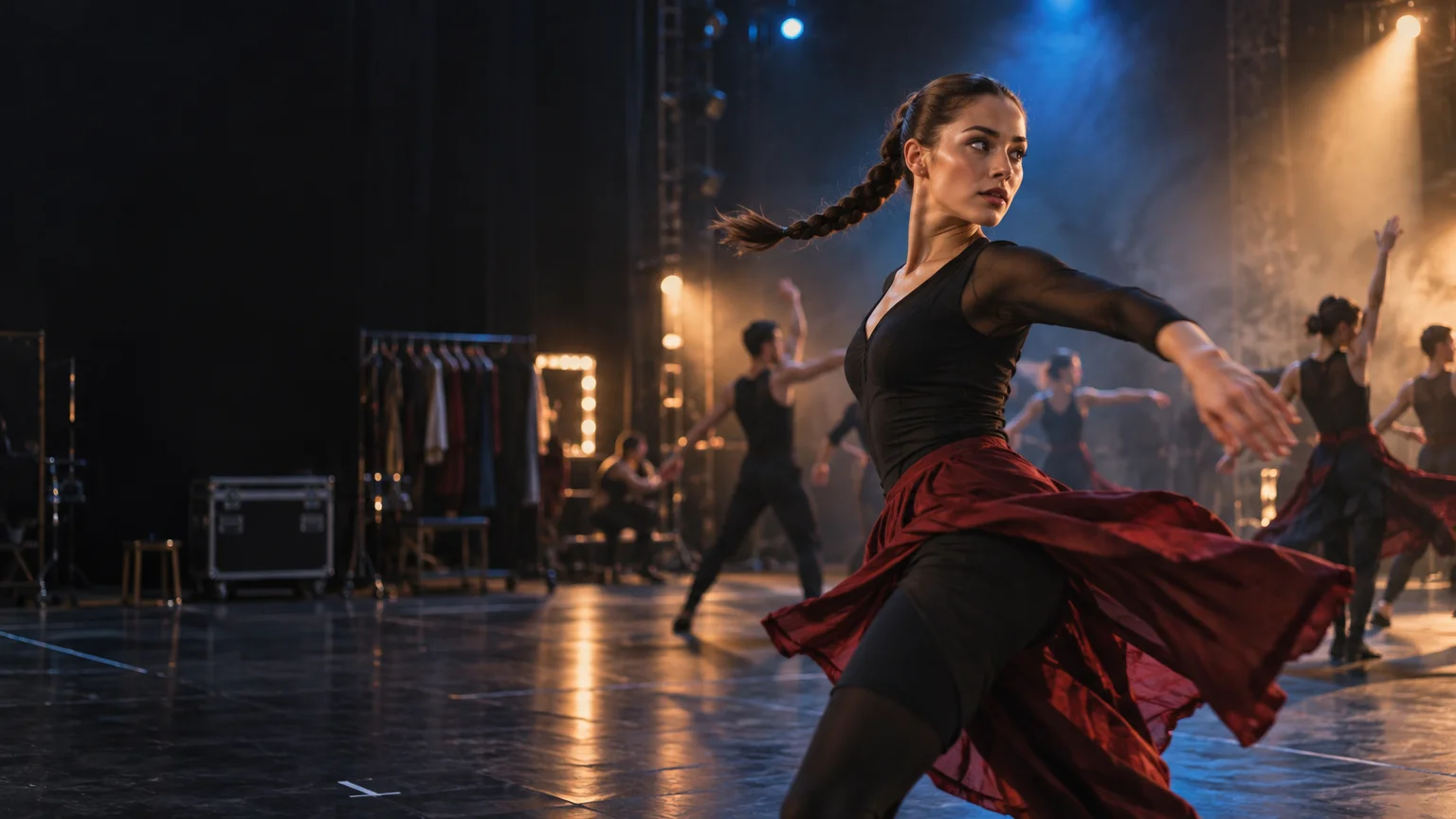
Hair for High-Movement Performance: Security Without Looking Rigid
TLDR
Performance hair high movement planning is not a contest to create the tightest possible style. The best hair plan survives the choreography, reads clearly under stage lighting, works with costumes and technical equipment, feels comfortable, and can be restored quickly between numbers. Map the movement first, choose the simplest suitable hair system, and test it full-out before show day.
A style is performance-ready only when it passes four tests: hold, comfort, visual impact, and reset. That standard applies whether the performer wears natural hair, braids, a ponytail, a structured updo, an added piece, or a full wig.
Performance hair high movement starts with a movement map
Begin with the choreography rather than a reference photo. A polished backstage still cannot show what happens during a head whip, inversion, floor slide, lift, hat change, or sweaty final chorus. Watch the number from beginning to end and identify the moments that place the greatest demand on the hair.
The movement map should include turns, jumps, rapid directional changes, floorwork, partnering, lifts, inversions, repeated head movement, and any moment when another performer comes close to the hair. Add production demands such as hot lighting, outdoor wind, headwear, masks, headset microphones, costume collars, jewelry, and quick changes.
| Show demand | What can go wrong | What the hair plan should address |
|---|---|---|
| Turns and head whips | Loose lengths obscure the face, lose their intended shape, or distract from group timing | Controlled movement, a readable silhouette, and a full-speed hold test |
| Floorwork and inversions | The style meets the floor, shifts, tangles, or catches against the costume | Placement, profile, contact points, and compatibility with floor choreography |
| Partnering and lifts | Hair enters a hand path or interferes with a grip or sightline | Clearance around planned contact points and testing with the actual partner |
| Sweat and hot lights | Shape changes, sections loosen, or the performer repeatedly touches the hair | A realistic endurance test and a defined touch-up plan |
| Headwear and microphones | Pressure points develop or equipment displaces the style | A combined fitting with hair, costume, headwear, and technical equipment |
| Quick changes | The next look takes too long or cannot be reproduced consistently | A timed sequence, assigned responsibilities, preset supplies, and an approved simplified backup |
| Touring or changing venues | Wind, humidity, stage dimensions, and backstage access vary | An adaptable version of the look and a compact reset kit for each performer |
This is the same audience-facing mindset used in rehearsal video review beyond synchronization. Hair should be observed in motion from the front, side, and rear—not judged only in a dressing-room mirror. For a touring production, build enough flexibility into the plan to handle the changing stages and backstage conditions discussed in building a high-energy touring dance show.
Use four tests instead of chasing maximum tightness
1. The hold test
Can the hair retain its intended silhouette through the number’s hardest movement? Test the actual sequence, not a gentle shake of the head. If the style changes, determine whether that movement is acceptable and expressive or whether it becomes distracting, blocks the face, or creates a safety problem.
2. The comfort test
Can the performer concentrate on timing, spacing, expression, and partnering without thinking about the hair? A style that causes pain, stinging, persistent tenderness, or pressure is not passing this test, even if it looks immaculate. Comfort should be checked at fitting, after a full-out run, and again after the style has been worn for a realistic period.
3. The visual test
Does the shape communicate the production’s world from the audience’s viewing distance? Look at the silhouette under show lighting and on rehearsal video. Decide whether intentional movement adds energy or makes the ensemble look untidy. Also check that the hair supports facial visibility rather than competing with expression.
4. The reset test
Can the look be checked and restored in the available backstage window? A beautiful system that demands a complete rebuild after every number may be wrong for a fast-moving show. Define what counts as an acceptable reset, who performs it, what supplies are preset, and what happens if the original look cannot be restored in time.
Choose the hair route that fits the show
There is no universal best hairstyle for dance or stage work. The right route depends on the choreography, character, performer, costume, technical equipment, schedule, and available hair support.
- Anchored natural-hair styles can preserve the performer’s own texture and avoid a separate hairpiece. They still need an adaptable plan for different lengths, densities, textures, and movement patterns across the cast.
- Braids or twists can control sections and create a strong visual rhythm. Their length, weight, swing, placement, and interaction with costumes or partners must be evaluated in motion.
- Ponytail and bun systems offer an immediately readable dance silhouette, but their placement changes how the head profile looks and where tension is concentrated. A style should not become more painful simply because the choreography is demanding.
- Partial pieces and extensions can add volume, length, color, or uniformity without replacing the full look. Treat every added component as production equipment that needs fitting, movement testing, maintenance, and an approved backup plan.
- Full wigs can create a major character transformation or consistent period silhouette. They require performer consultation, correct fitting, compatibility checks, full-out rehearsal, and a clear reset process rather than last-minute improvisation.
- Character or period hair may prioritize a specific sculptural shape. If historical accuracy conflicts with movement, comfort, or change time, the creative team should define which visual features are essential and where adaptation is acceptable.
Cast consistency does not require identical treatment for every head of hair. It requires a shared visual target. A choreographer might specify a clean side profile, visible facial lines, controlled lengths, and a particular amount of movement while allowing the preparation and construction to vary by performer.
Plan wigs and hairpieces as production systems
A wig or added piece should never make its debut during the performance. Fit it with the performer, then test it with the complete costume and any hats, helmets, masks, earrings, collars, in-ear equipment, or microphones used in the number. The performer should complete the difficult choreography while the appropriate production team observes the result.
Avoid treating one installation method as universally correct. A qualified hair or wig professional should determine the appropriate fitting and attachment approach for the performer, piece, choreography, skin and scalp needs, and production conditions. The useful questions for the wider team are operational: Does it remain correctly positioned? Does anything interfere with movement or equipment? Can the performer report discomfort immediately? Can the look be reset on schedule?
Prepare an approved response for a shifting or damaged piece. That might mean moving to a simplified version of the look, substituting a prepared backup, or making a planned costume adjustment. The goal is not to encourage an untrained person to attempt a complicated repair in the dark. It is to remove uncertainty before the cue arrives.
Secure should not mean painful
The American Academy of Dermatology warns that hairstyles which repeatedly pull on the hair can cause traction alopecia. Its guidance identifies pain, stinging, crusting, and a tented appearance of the scalp among signs that a style may be too tight. The organization also notes that people whose work repeatedly requires pulled-back hair, including ballet dancers, can face greater risk from traction-related practices. Performers and production teams can review the AAD’s guidance on hairstyles that pull for the full warning signs and prevention context.
This does not mean every structured style or wig is inherently unsafe. It means discomfort should not be interpreted as proof that the hair is secure. Persistent pain, stinging, tenderness, visible pulling, scalp changes, or breakage warrants pausing and reassessing the plan. A performer with continuing symptoms or hair loss should seek advice from an appropriate healthcare professional.
A 2026 Pediatric Dermatology case report described focal traction alopecia in three young Irish dancers associated with traditional wig use during high-energy dance. Because this was a three-patient case report, it cannot establish how common the problem is among dancers or support sweeping conclusions about all performance wigs. It does reinforce the value of noticing symptoms early and changing contributing practices when problems appear.
Build a hair bible the whole team can use
Once the look works, document it. USITT’s makeup-design award guidance recognizes hair-creation documentation, tracking charts, and quick-change information as part of the production process, reflecting how seriously professional design workflows treat repeatability. A useful hair bible turns that principle into a practical show document.
- Reference images showing the approved front, side, and back views
- A short description of the intended silhouette and movement quality
- Acceptable adaptations for different hair lengths, textures, densities, and performer needs
- The costume, headwear, microphone, and jewelry used with each look
- Preparation responsibilities for the performer and hair team
- Estimated styling, change, inspection, and reset windows verified in rehearsal
- A numbered quick-change sequence with clear handoffs
- Preset locations for approved tools, supplies, backups, and cleanup materials
- The person authorized to approve a change or simplified emergency look
Photograph the version that actually passed rehearsal, not an aspirational version created before choreography and costumes were integrated. When a detail changes, update the document so the cast is not working from several conflicting reference images.
Run the full-out rehearsal test
The decisive test happens when the performer dances at show intensity. Place the hair under the same demands it will face in performance and record the run when possible. Watch for gradual drift as well as dramatic failure: a section creeping toward the eyes, a piece rotating slightly, a microphone becoming exposed, or a silhouette losing consistency across the cast.
After the run, ask the performer what the audience cannot see. Did pressure increase? Did a pin, seam, edge, or accessory become noticeable? Did the performer avoid a movement because the hair felt uncertain? Could they hear or feel the piece shifting? Performer feedback is part of the test data, not an obstacle to the design.
Pre-show hair checklist
- The style or piece has completed the hardest choreography at full intensity.
- Front, side, and rear views have been checked under representative lighting or on video.
- The performer can move fully without pain, stinging, persistent tenderness, or distracting pressure.
- Hair, costume, headwear, jewelry, and microphone equipment have been tested together.
- Partner grips, lifts, floor contact, and close formations have been checked where relevant.
- The quick change has been timed with the actual route, crew, costume, and backstage conditions.
- Reset supplies and approved backups are labeled and preset.
- The performer knows whom to contact if the style becomes uncomfortable or unstable.
- The team has an approved simplified option rather than relying on an improvised repair.
Make the style serve the performance
High-movement hair succeeds when the audience sees intention while the performer feels free to attack the choreography. Start with the movement map, select the least complicated system that achieves the visual goal, and test hold, comfort, appearance, and reset under real show conditions.
The next practical step is simple: bring the planned hair, costume, headwear, and technical equipment into the same full-out rehearsal. Record the hardest section, gather performer feedback immediately afterward, and revise anything that shifts, interferes, hurts, or takes too long to restore. Security comes from testing and coordination—not from making the style progressively tighter.