Rehearsal Video Review: What to Watch Besides Synchronization
TLDR
Treat dance rehearsal video review as a correction loop, not a verdict. Film one clear run, choose one playback focus, write no more than three timestamped notes, drill those moments, and record another pass. Look beyond synchronization to choreography accuracy, musicality, spacing, transitions, focus, intention, and the overall stage picture.
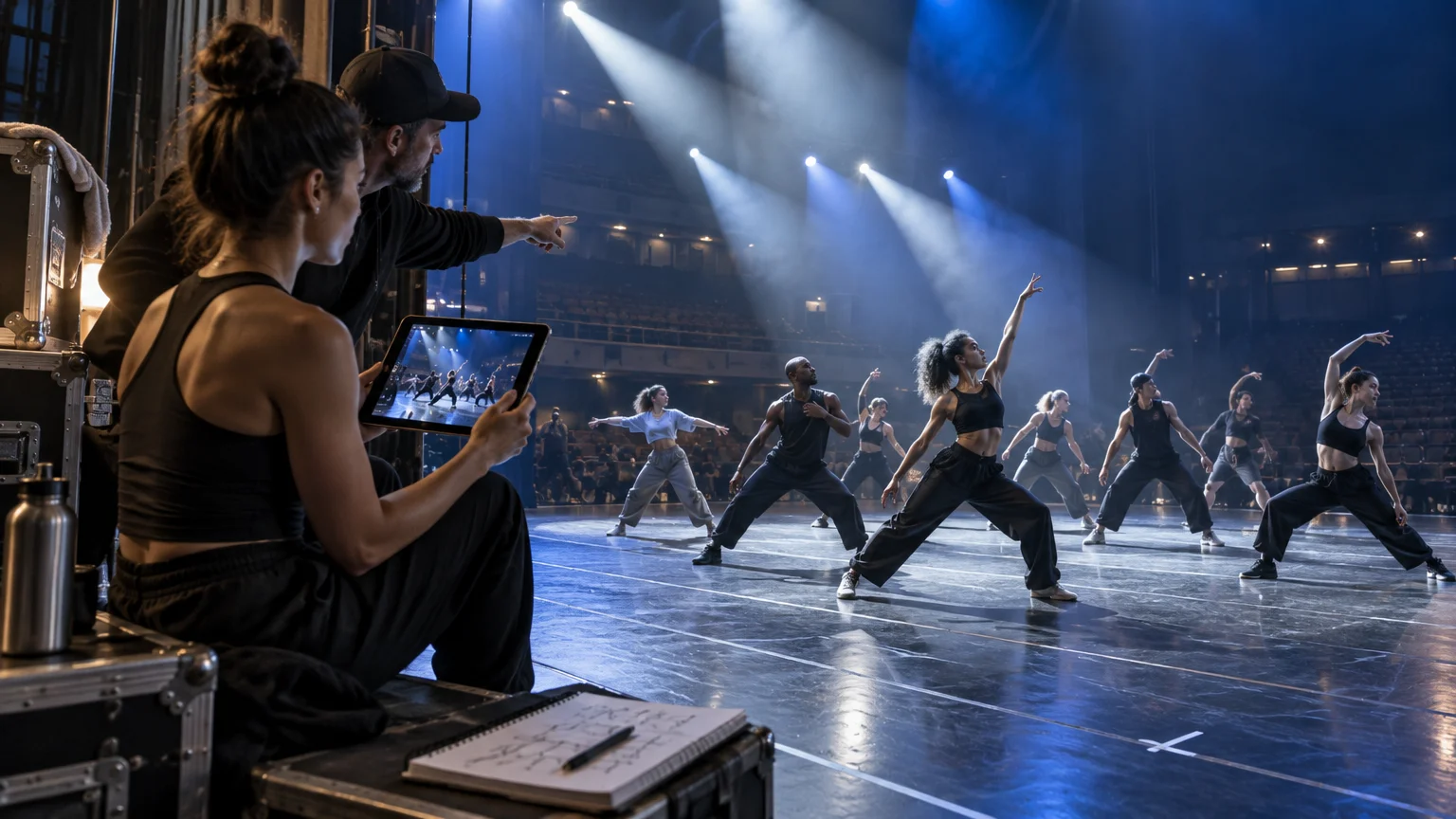
The camera catches what rehearsal-room adrenaline can hide: a formation that reads as a clump, a transition that drains the energy, or a strong move that arrives without a clear intention. The useful question is not “Did everyone match?” It is “What will the audience notice, and what physical change can improve it on the next run?”
A productive dance rehearsal video review stays narrow. Trying to correct feet, faces, spacing, timing, arms, and performance quality in one screening creates a pile of observations but no clear rehearsal task. Watch the same run through one lens at a time, select the issue with the greatest audience impact, and return to the floor.
Use a five-step review loop
Video helps most when playback leads quickly back to movement. Dance educators Buday and Jones describe using smartphone recording for immediate self- and peer-review, focusing on selected movement sequences and then returning to physical experimentation rather than letting playback replace dancing. Their discussion of personal video feedback in dance classes also highlights the useful contrast between how movement felt and what was visible on screen.
- Capture one usable run. Record the whole phrase, including its cue-in and final hold, without stopping for every imperfection.
- Select one review lens. Choose choreography, timing, spacing, transitions, unison, or performance intention before pressing play.
- Write timestamped, actionable notes. Identify what is visible, when it happens, and what the dancer should try next.
- Drill the passage. Work the smallest section that contains the problem, including the movement immediately before and after it.
- Record the next pass. Compare the same moment under similar filming conditions and decide whether to keep, refine, or replace the correction.
This is a loop, not a courtroom. A small study involving four adolescent competitive dancers found improved performance with video modeling and further improvement when video feedback was added. That result supports video as a potentially useful coaching tool, but the sample is far too small to promise the same outcome for every dancer, team, or style.
What to watch besides synchronization
Synchronization is only one layer of a stage picture. A cast can hit the same count and still look uncertain because the pathways are muddy, the accents lack contrast, or nobody appears to know where the audience should look. Use the following categories as separate playback passes rather than one giant checklist.
| Playback focus | What to look for | Next rehearsal action |
|---|---|---|
| Choreography accuracy | Missing steps, reversed directions, altered arms, inconsistent levels, or unclear facings | Mark the exact phrase slowly, confirm the agreed version, and repeat it from the preceding transition |
| Timing and musicality | Whether movement lands on the intended beat, lyric, accent, breath, suspension, or silence | Name the musical cue, clap or speak the rhythm, then dance the phrase with and without music |
| Spacing and formations | Uneven gaps, hidden dancers, drifting lines, blocked sightlines, or pathways that nearly collide | Set visual landmarks or floor marks and rehearse the travel into the formation |
| Unison | Differences in initiation, pathway, shape, level, or completion—not merely the final pose | Choose one shared initiation and endpoint, then compare the route each body takes between them |
| Transitions | Energy dropping between phrases, late exits, hesitant turns, costume adjustments, or performers looking for their next mark | Rehearse the exit and entrance as choreography, beginning before the transition and ending after the new picture settles |
| Performance intention | Unclear focus, generic facial presentation, competing focal points, or movement with no apparent objective | Assign an intention, focal direction, or audience target and test whether it reads without exaggeration |
Start with the issue that changes the stage picture
There is no universal order for reviewing choreography, timing, spacing, and performance. Prioritize by consequence. A dangerous collision path comes before a soft hand. A dancer facing the wrong direction comes before subtle facial detail. A formation that hides the featured performer may matter more than a small timing difference in the back line.
For a touring or adaptable production, spacing deserves particular attention because choreography may need to survive changing stage dimensions and entrances. That broader challenge is part of building a high-energy touring dance show, where the work must hold together beyond one familiar rehearsal room.
Separate mistakes from design problems
A missed step is not the same as a weak stage picture. If one dancer forgets a turn, correct execution. If everyone performs the choreography accurately but the formation still looks crowded, the design may need adjustment. If dancers repeatedly arrive late, inspect the travel time and preceding move before assuming the cast simply needs more effort.
This distinction protects rehearsal time. It also keeps dancers from being blamed for structural problems in choreography, staging, or cueing. Video can expose the symptom; the rehearsal leader still has to diagnose the cause.
Film for diagnosis, not for social media
A useful rehearsal recording does not need cinematic movement or dramatic editing. Place the camera in a stable position, far enough back to retain full bodies, entrances, exits, and travel patterns. A centered audience-facing angle is usually the best starting point for formations, although a side view may be more useful when checking depth, lifts, or traffic through the wings.
Keep the cue-in and final hold. The moments before and after a phrase often reveal rushed preparation, early relaxation, or uncertainty about when the performance begins and ends. Favor a continuous take over stylized cuts because an edit can hide the transition you most need to inspect.
No camera view is neutral. Distance can flatten energy, a wide-angle lens can distort dancers near the frame edges, mirrors can duplicate bodies, and poor lighting can erase detail. The Victorian Curriculum and Assessment Authority notes that video can document dance-making and rehearsal while supporting feedback and collaboration; its guidance for using video in dance also calls for thoughtful attention to camera viewpoint and editing effects.
For comparison, keep the camera position and framing reasonably consistent between takes. You are not trying to produce a flawless visual record. You are trying to make the before-and-after footage similar enough that a real staging change is not confused with a new angle.
Review yourself without turning playback into punishment
Self-review can slide quickly from observation into harsh judgment. Replace labels with visible events. “I look terrible” offers no next move. “At 00:38, I look down during the diagonal travel and lose the audience-facing focus” identifies both the moment and a testable correction.
Use three questions during a solo review:
- What happened that I can point to on screen?
- What was I trying to make the audience see or feel?
- What single physical adjustment can I test in the next pass?
Video and mirror practice answer different questions. A mirror gives immediate information while movement is happening, but it can pull the eyes toward the reflection and change focus. Video delays the feedback but shows a completed run without requiring the dancer to monitor the image in real time. Use the mirror to investigate a shape; use playback to inspect how that shape arrives, travels, and reads in sequence.
Make group review fast, specific, and respectful
A team screening can become a flood of opinions unless someone controls the sequence. Let dancers observe themselves first, then invite peer or leader notes. This reduces the chance that the loudest voice defines the entire review before performers have processed what they see.
Limit the next run to one to three corrections. A dance captain might say, “At 01:12, the second line begins traveling before the first line clears. Hold through the vocal cue, then cross on the drum hit.” That is more useful than “The transition is messy” because it names the location, visible event, and next action.
Constructive notes should address choices and actions rather than bodies or personalities. Useful language sounds like this:
- Instead of “You have no energy,” try “Finish the arm pathway through count six and sustain your focus through the hold.”
- Instead of “Your line looks wrong,” try “Your downstage foot is about half a step beyond the line at 00:47; test the entrance from the previous eight-count.”
- Instead of “Everyone is late,” try “The group initiates on different sounds. Let’s agree that the shoulder begins on the lyric and the turn completes on the snare.”
- Instead of “Make it bigger,” try “Increase the travel on counts one through four while keeping the final formation centered.”
After the second recording, compare only the targeted moments. If the correction worked but created another issue, keep the useful part and adjust the consequence. If nothing changed, revise the instruction rather than repeating it more loudly.
Keep footage organized—and know where it can go
Record key runs and problem sections rather than creating an archive nobody can navigate. A simple file name such as “show-opening-transition-2026-03-12-take2” is more useful than a camera roll full of unnamed clips. Review promptly while the run, correction, and physical sensation remain easy to recall.
Keep internal rehearsal review separate from public sharing. Before recording or distributing footage, verify the relevant studio, school, venue, employer, or production policy. Permission to record for coaching should not be treated as automatic permission to post, promote, or send the clip outside the approved group.
Policies may address consent, performers who are minors, ownership, and withdrawal of permission. A University of Washington Department of Dance classroom recording release, revised in February 2024, provides one example of permissions that distinguish classroom recording from promotional use. It is an institutional example, not a universal legal rule.
Also consider what appears in the background: other classes, visitors, choreography not cleared for release, production documents, costumes, music, or performers who did not agree to be filmed. When the policy is unclear, pause distribution and ask the responsible teacher, producer, company manager, or venue representative.
Your next rehearsal review
At the next call, film one uninterrupted wide run. Pick the audience-facing issue with the greatest impact. Write three timestamped notes at most, drill those exact passages, and re-film from the same position. Then ask one decisive question: did the correction make the performance clearer?
That is the real purpose of dance rehearsal video review. The screen is not there to collect flaws or manufacture a polished clip. It is there to turn one visible problem into one physical experiment—and send the dancers back onto the floor with a sharper plan.
References
- Self and peer review in dance classes using personal video feedback » Ausdance | Dance Advocacy
- Evaluating video modeling and video modeling with video feedback to enhance the performance of competitive dancers – Quinn – 2020 – Behavioral Interventions – Wiley Online Library
- Advice for teachers -Dance – Victorian Curriculum and Assessment Authority
- dance.washington.edu