Partnering Basics for Entertainment Choreography
Partnering begins long before anybody leaves the floor. Its real foundations are self-carriage, timing, spatial awareness, communication and a clear agreement about contact. When those pieces work, even a simple hand connection can feel electric. When they do not, adding a bigger lift merely makes the confusion more dangerous.
For entertainment choreography, the goal is not to collect tricks. It is to create a relationship the audience can read while giving both dancers enough information to move decisively. That relationship might look romantic, combative, playful, competitive or purely architectural. Whatever the story, the dancers need a repeatable physical system underneath it.
TL;DR: The partnering essentials
- Begin with dancers who can control their own alignment, momentum and weight.
- Establish consent, boundaries and a shared vocabulary before rehearsing contact.
- Develop awareness through mirroring, unison and action-and-reaction exercises before adding weight.
- Treat leading and following as responsive roles, not gender assignments.
- Progress from light contact to counterbalance and shared weight gradually.
- Set entrances, exits, hand placements, timing and recovery options as carefully as the featured shape.
- Attempt lifts only with suitable instruction, preparation, staffing and rehearsal conditions.
- Adapt the choreography to the actual dancers and performance space rather than forcing one idealized version.
Partnering is bigger than lifting
A duet can establish a strong partnership without elevation or even touch. Mirroring, question-and-answer phrasing, unison, canon, contact and basic weight-bearing work are all established relationship devices. One Dance UK places those tools alongside changes in action, space and dynamics, plus compositional ideas such as transitions and climax.
That gives a choreographer a much richer starting palette than “find a lift.” Two dancers can cross identical pathways half a count apart, redirect one another with a glance or create tension by repeatedly closing and reopening the distance between them. These choices introduce the relationship before physical complexity arrives.
Partnering methods also change with the form. A codified social or ballroom sequence may use defined lead-and-follow techniques and counts. Contemporary choreography might establish a task, pressure or pathway and ask the dancers to respond in real time. In both cases, the partnership depends on attention. The Imperial Society of Teachers of Dancing emphasizes control, sensitivity, responsive leading and following, rhythm, posture and floorcraft in its partner-dance materials.
The five foundations dancers need first
1. Self-carriage
Each dancer must organize their own body before asking a partner to help organize it. That does not mean staying rigid. It means maintaining active support through the phrase instead of going limp, hanging unexpectedly or sending uncontrolled momentum into the other person.
Reported advice from professional dancers and choreographers stresses that the supported dancer should retain control of their body and weight rather than collapse into a partner. A useful rehearsal prompt is: “If the contact disappeared, what could you still control?” The answer need not be “everything,” especially in genuine shared-weight material, but the question exposes accidental dependence.
2. Responsive attention
Good partners do not simply execute adjacent steps. They monitor pressure, direction, timing and change. Choreographer Ilya Vidrin has described partnered movement as an ongoing negotiation involving pressure, release, potential energy and changing position. That image is useful: partnering is less like carrying furniture and more like holding a live conversation.
Dancers can train that attention with a slow palm-to-palm exercise. One dancer changes level, direction or pace while the other maintains a light, consistent connection. Switch roles, then remove the assigned leader and let initiative pass between them. The objective is not to guess. It is to notice information early enough to answer without grabbing.
3. Clear roles without gender rules
Leading, following, supporting and being supported are movement jobs. They are not automatic statements about gender, size, status or character. ISTD explicitly describes leader and follower as roles open to dancers of all genders and supports learning either role. Entertainment choreography becomes more versatile when performers can initiate, receive, redirect and exchange those jobs within the same phrase.
Name the job at each difficult moment. Who initiates the travel? Who establishes the base? Who supplies momentum? Who controls the descent? If the answers change halfway through a transition, mark the handoff in the counts. Ambiguous responsibility creates hesitation; an intentional exchange of responsibility creates drama.
4. Consent and boundaries
Contact should never be treated as silent permission granted for an entire production. A useful rehearsal check-in identifies where touch or partnering will occur, gives partners time to discuss boundaries and invites direct consent from the people performing the action. The Dance Data Project’s touch and consent guidance also recommends a check-out process after the session.
Be specific. “Is partnering okay?” is less useful than “May I place my right hand at your left waist for this transition?” Establish alternatives for any contact that is declined or modified. University of Iowa dance policies treat instructional touch broadly, including partner demonstrations, contact choreography and contact improvisation, and call for consent-based processes and boundary practices in intimate material.
Consent and choreographic clarity reinforce each other. Exact contact points reduce surprises, while a defined process for pausing and revising material keeps dancers from having to choose between personal boundaries and holding up rehearsal.
5. Shared timing
Most partnering failures appear to be strength problems because that is what the audience sees. Often, the earlier cause is timing. One dancer arrives before the base is established, changes direction without preparing the partner or releases before the other dancer has recovered independent balance.
Rehearse the approach and exit as seriously as the central picture. Count the preparation, identify the breath or visual cue and agree on the precise moment pressure begins. Then define how it ends. A clean recovery can make modest material look luxurious; a scrambled exit can erase the effect of the most impressive shape.
A sensible progression from no contact to shared weight
| Stage | Rehearsal focus | What the choreographer watches |
|---|---|---|
| No-contact relationship | Mirroring, unison, canon and action-and-reaction | Shared focus, readable intention and spatial accuracy |
| Light connection | Palm, forearm or another agreed contact point | Consistent tone without gripping, pulling or surprise |
| Guided travel | Direction changes and pathways through space | Early cues, controlled momentum and clear right of way |
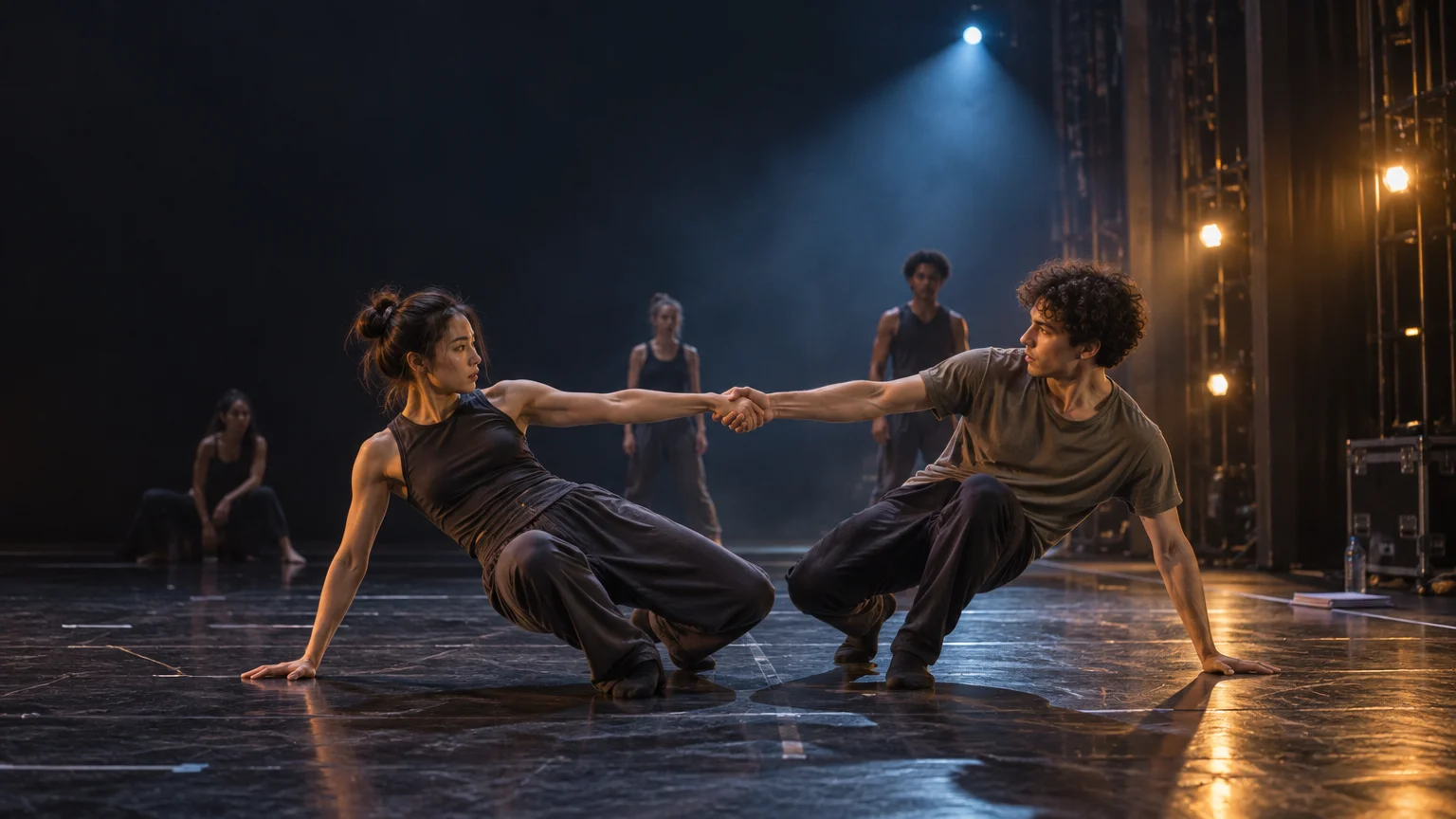
| Counterbalance | Partners move away from a mutually organized connection | Gradual loading, stable placement and a planned return |
| Shared-weight transitions | One dancer accepts a defined portion of the other’s weight | Preparation, breathing, timing and reliable exits |
| Elevation | Appropriately taught and supervised lift material | Suitable technique, staffing, space, floor and recovery plan |
Do not treat this table as permission to advance automatically. Dancers may move at different rates, and a new partnership should rebuild communication even when both performers have substantial individual experience. A technically advanced dancer is not automatically familiar with another person’s timing, proportions or boundaries.
Height differences, recurring collision points and usable space vary from pairing to pairing, so duet material is often adapted to the dancers rather than imposed unchanged. Modification is not a failure of choreography. It is part of finishing the choreography.
How to build a partner phrase in rehearsal
- Define the relationship. Decide what the audience should understand about these two performers.
- Map the pathways without contact. Confirm facings, levels, traffic patterns and available space.
- Agree on contact. Name the body part, purpose, timing and acceptable alternatives for each touch.
- Add one connection. Rehearse it below performance speed until pressure and direction are predictable.
- Assign responsibility. Identify who initiates, supports, redirects and completes every transition.
- Add dynamics. Change speed, resistance, suspension or attack without sacrificing the agreed pathway.
- Rehearse the exit. Make each dancer’s return to independent control part of the phrase.
- Test in context. Add costumes, footwear, music, lighting conditions and surrounding performers progressively.
- Review together. Ask what felt clear, late, rushed, unstable or physically uncomfortable, then revise.
Focused communication keeps this process moving. Performer advice reported by Dance Spirit emphasizes respectful discussion of corrections, concerns and boundaries. Replace vague comments such as “You dropped me” with observable information: “My supporting foot was still traveling when the weight arrived.” Specific language gives the partnership something it can change.
Make the choreography readable from the audience
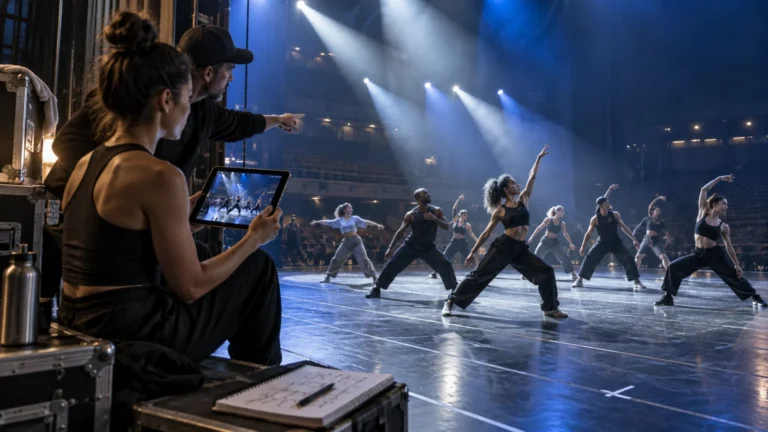
A technically sound connection can still disappear onstage if the audience cannot read its purpose. Start by identifying the visual headline. Is the moment about trust, resistance, speed, danger, tenderness or comic miscommunication? Shape the dancers’ focus, spacing and dynamics around that idea.
Then edit. Too many grip changes can turn a fluid exchange into visible administration. Too much preparation can announce the trick before it happens. Too little preparation hides essential information from the dancers. Keep what the performers need, disguise it within character and remove movement that competes with the main event.
Use contrast to increase impact. A burst of tight unison can make a later separation feel enormous. A suspended pause before a directional change gives the audience time to register uncertainty. A low, grounded shared-weight passage can make a later jump feel brighter without requiring a dangerous escalation.
Rehearse for the stage you actually have
Partnering needs suitable conditions. One Dance UK’s industry standards for dance identify appropriate flooring, unobstructed space and sufficient ceiling height for jumping, leaping and lifting as relevant safe-practice considerations. The standards also address warm-ups, cool-downs, rest, hydration, workload and injury prevention.
Before full-out rehearsal, check the floor, overhead clearance, wings, nearby scenery and traffic from the surrounding cast. Account for costumes that reduce vision or alter grip, accessories that can snag, and footwear that changes traction. If the production travels, document an adaptable version rather than assuming every venue will reproduce the original conditions.
Touring choreography regularly has to survive changing stages and event environments. A phrase may need one version for a full stage and another for a shallow platform or crowded convention setup. That same adaptability is central to building a high-energy touring dance show: preserve the visual intention, but adjust spacing and technical demands to the room.
Common partnering problems and useful corrections
- The connection feels rough: Reduce speed and examine when pressure starts, changes direction and releases.
- One dancer is doing all the work: Separate intended support from accidental collapse, then clarify each person’s responsibility.
- The phrase looks cautious: Confirm the pathway slowly, establish a reliable cue and increase speed in controlled stages.
- Partners keep colliding: Recheck facings, limb pathways and the distance required by these particular bodies.
- Hands keep searching: Specify placement and give the receiving dancer a repeatable orientation.
- The central shape works but the exit falls apart: Choreograph the recovery counts instead of treating them as empty space.
- A dancer is uncomfortable with contact: Pause, discuss the specific boundary and create another choreographic solution.
- The material only works in one room: Build compact, standard and expanded spacing options before the production travels.
The stage-ready partnering checklist
- Can both dancers describe the intention of the phrase?
- Are all contact points agreed, specific and repeatable?
- Does each transition have a clear initiator and receiver?
- Can the dancers identify the cue for loading, redirection and release?
- Are entrances and exits controlled at rehearsal speed and performance speed?
- Has the material been adapted to the dancers rather than copied mechanically?
- Is the floor clear, suitable and unobstructed?
- Is there enough lateral and overhead space for the planned movement?
- Have costume, footwear, props and surrounding traffic been introduced safely?
- Is there a lower-risk alternate version if conditions change?
- Do the dancers have a straightforward way to pause, report discomfort and revise the material?
Build trust before spectacle
The strongest partnering often feels inevitable: one performer changes direction, the other is already there, and the audience sees a relationship rather than a procedure. That ease is built through exact contact, active self-support, shared timing, consent and dozens of small adjustments.
Begin with a short duet that uses mirroring, one agreed hand connection, a guided direction change and a clean separation. Make those elements clear enough to perform under stage lights. Only then add counterbalance, shared weight or elevation appropriate to the dancers’ training and rehearsal support. In partnering, trust is not a mood added at the end. It is the choreography’s operating system.
References
- This Framework sits within a suite of Frameworks which
- www.istd.org
- The Dos and Don'ts of Partnering
- What Gets Lost When the Body Becomes Data — Jacob's Pillow
- ddp-wordpress.storage.googleapis.com
- Dance Policies and Additional Guidelines | Performing Arts Callboard – The University of Iowa
- Industry Standards for dance | One Dance UK