Why Costume Spectacle Has Always Mattered in Revue Performance
TLDR
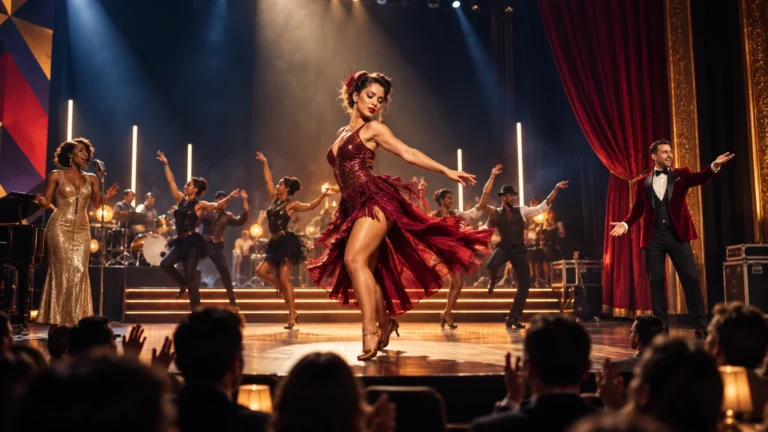
Costume spectacle has always mattered in revue because the form moves quickly. Without one continuous plot to introduce every personality and setting, clothing must establish character, mood, status and scale almost instantly. From music-hall comic types and Ziegfeld formations to Black Broadway revues and Las Vegas production shows, costume has functioned as storytelling, choreography, scenery and publicity at once. The best revue costumes do not merely sparkle under stage lights. They organize what the audience sees.
A revue can turn from satire to a romantic song, then leap into a specialty dance or a grand finale without apologizing for the change. That restless structure is its thrill—and its design problem. Every new number has only moments to announce itself. A silhouette appears. A color catches the light. A chorus advances down a staircase. Before a lyric explains the scene, costume has already told the room how to look at it.
Why costume carries so much weight in a revue
Unlike a conventional book musical, a revue is generally constructed as a sequence of separate numbers. Music, dance, comedy, satire, topical commentary, sound and visual design can coexist without serving a single continuous narrative. The form’s fragmentation makes contrast part of the entertainment rather than a flaw to disguise. The Oxford Handbook of the British Musical’s discussion of West End revue describes this sequence-based theatrical tradition and its combination of performance elements.
That structure gives costume several jobs at once. It has to make a new number readable, distinguish principals from the ensemble, support the performer’s movement and create enough visual contrast that one sequence does not blur into the next. In a plot-driven show, audiences may spend scenes learning who a character is. In revue, a performer may have eight bars, one entrance and a perfectly cut coat.
- Instant identification: A costume can establish a comic type, romantic lead, glamorous chorus or novelty character before the performer speaks.
- Visual punctuation: A sudden change in color, volume or silhouette tells the audience that the show has entered a new world.
- Ensemble composition: Matching or coordinated costumes turn individual bodies into lines, fans, diagonals and moving patterns.
- Star distinction: A principal can remain visually dominant even while surrounded by a large chorus.
- Memory and promotion: A striking look can become the image audiences associate with the entire production.
Costume spectacle was therefore never an optional layer pasted onto revue. It was part of the form’s grammar.
The mixed bill demanded immediate visual storytelling
The revue inherited much from nineteenth-century French end-of-year productions and from British music hall and variety. These environments mixed songs, comedy, dance, topical jokes and specialty acts, often with performers who needed a recognizable identity that could survive a short turn on a crowded bill.
Clothing helped make that identity portable. Comic performers could build recurring types through dress. Novelty artists used unusual shapes, props and transformations to sharpen their premise. Stars cultivated silhouettes audiences could recognize from the back of a balcony—or in a publicity photograph outside the theatre.
The V&A’s history of music hall and variety theatre points to Vesta Tilley’s celebrated male-impersonation act as one example of clothing doing cultural as well as theatrical work. Her tailored male costumes supported the act while challenging conventions surrounding women wearing trousers. The clothes were not simply accurate accessories. They created the argument of the performance.
This visual economy remains central to the pacing and contrast inherited from variety entertainment. A mixed bill succeeds when every act has its own temperature but still feels selected for the same evening. Costume is one of the fastest ways to establish those differences.
Ziegfeld turned the chorus into a moving stage picture
Florenz Ziegfeld’s first Follies opened in July 1907, and the annual production became known as the Ziegfeld Follies from 1911. Its editions combined comedy, music, dance and costly production numbers. The Follies did not invent theatrical glamour, but they helped make carefully composed visual abundance a defining Broadway attraction.
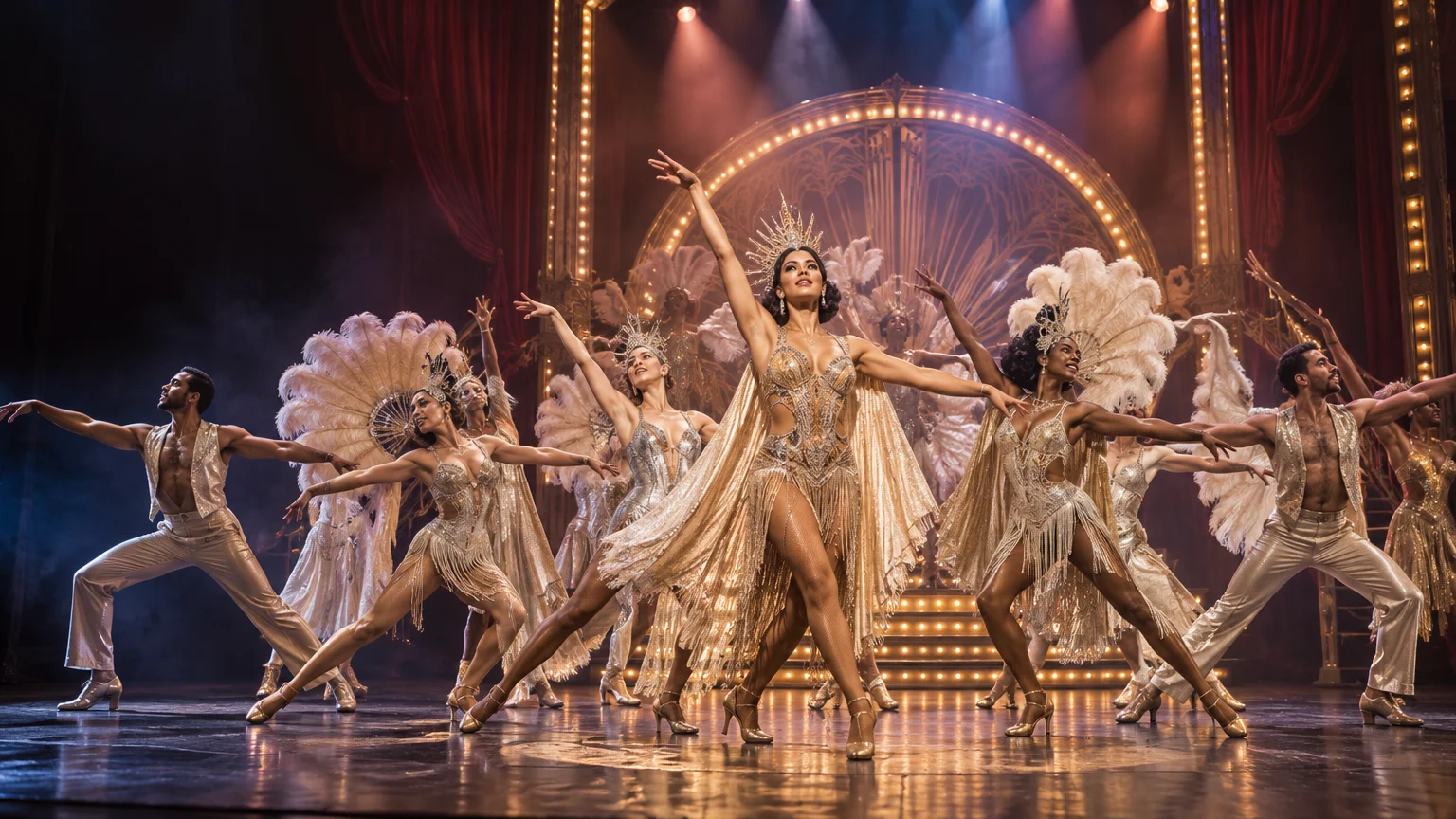
In this tradition, the chorus was more than a group dancing behind a star. Performers became elements in a large composition built from gowns, headwear, stairs, lighting, spacing and synchronized entrances. A costume’s line could extend the body upward, widen a formation or make a slow crossing feel monumental. Repetition multiplied the effect: one ornate silhouette became an image; twenty related silhouettes became architecture.
It is tempting to flatten this lineage into feathers, rhinestones and a staircase. The surviving design record shows something richer. American variety and musical-stage spectacle incorporated ornate gowns, sculptural headwear, comedy, star turns, chorus formations and changing approaches to lighting and visual composition. Revue costume history is not one look. It is a history of designers repeatedly finding new ways to make bodies command large stages.
Black revue expanded the form under unequal conditions
Any account of American revue must also recognize the Black artists who transformed musical theatre while confronting racist performance conventions. The Library of Congress notes that Black vaudeville performers were often required to appear in blackface into the early twentieth century. Noble Sissle and Eubie Blake refused to do so in 1919, a decision that gives essential context to the work they would bring to Broadway.
Shuffle Along opened on May 23, 1921. The Library of Congress identifies it as the first Broadway musical written, produced and performed by African Americans. It ran for more than 500 performances, sent out three touring companies and featured a chorus that included Josephine Baker and Ethel Waters. Its success demonstrated the commercial and creative force of Black musical theatre even as its artists worked within an industry shaped by segregation and stereotype.
Costume in Black revue could support elegance, modernity, comic characterization, ensemble precision and star presence. But visual analysis must account for who controlled the image and which conventions performers were pressured to negotiate. Spectacle is never politically neutral simply because it is beautiful. The stage picture can reflect restriction, resistance and ambition at the same time.
A spectacular costume changes the choreography
The glamour visible from the auditorium begins as a practical negotiation backstage. Weight, balance, attachment points, sightlines, footwear and quick-change timing determine how a performer can move. A towering headpiece may demand a quieter upper body. A long train changes turns and spacing. Reflective trim can clarify movement under one lighting state and disappear under another.
This relationship became especially visible in the French-style production shows that shaped Las Vegas entertainment. Lido de Paris arrived at the Stardust in 1958, Folies-Bergère followed at the Tropicana in 1959 and Casino de Paris opened at the Dunes in 1963. UNLV reports that the last classic Las Vegas showgirl production closed in 2016. UNLV’s showgirl collections history documents this production lineage and the design practices around it.
Within these shows, the showgirl was a distinct role rather than a generic name for every woman in the cast. Covered dancers and topless dancers performed more choreography, while showgirls often displayed elaborate costumes through controlled walks and poses. Heavy or restrictive headpieces helped shape that movement vocabulary. The famous walk was not an absence of technique. It was technique adapted to an object worn on the body.
UNLV characterizes showgirl design as an interaction among color, texture, line, shape, the moving body and stage lighting. Some production numbers became known by their costumes rather than their music—a revealing reversal in which the visual concept was effectively the number’s title. Readers interested in that distinct branch of the tradition can continue with the evolution of Las Vegas showgirls.
The designer has to think beyond the drawing
A beautiful rendering is only the opening proposition. Costume designer Florence Klotz’s surviving sheets show how theatrical design joins visual imagination to production engineering. They combine figure drawings with fabric swatches, performer measurements and construction information. Her work also demonstrates the need to consider choreography, scenery, props, fabric behavior, stage-light color and rapid changes. The Library of Congress profile of Florence Klotz offers a close look at these working documents.
For a revue designer, the practical questions arrive fast:
- Can the performer execute the required steps safely and at full scale?
- Will the silhouette remain clear against the scenery and surrounding ensemble?
- Does the fabric react well to the actual lighting rather than the workroom light?
- Can the costume survive repeated entrances, travel, sweat and hurried handling?
- Is there enough time to remove it and establish the next look?
- Do trims, closures and accessories create hazards for adjacent performers?
- Can the wardrobe crew identify, preset and repair every component efficiently?
These constraints do not diminish spectacle. They make it possible. A costume that looks magnificent while preventing the performer from hitting a mark has failed the number. A less obvious fastening choice that saves twelve seconds during a change may protect the rhythm of the entire show.
Costume became scenery, transition and dramatic memory
By the middle of the twentieth century, integrated book musicals had largely displaced revues as Broadway’s dominant form, but revue spectacle did not vanish. Its methods migrated into musical staging, television variety, casino production shows, concert tours, awards broadcasts and fashion-driven pop performance. Whenever a costume change announces the next chapter before the scenery moves, revue logic is still at work.
Stephen Sondheim’s Follies, first produced in 1971, made that inheritance part of its drama. The show used memories of revue glamour and its aging performers to place theatrical splendor beside loss and disillusionment. Florence Klotz’s costumes earned her first Tony Award. Here, spectacle was not merely nostalgic decoration. It was the substance of what the characters remembered and what time had taken away.
That example helps explain why historic costumes remain so emotionally potent. Clothing preserves the scale at which performers once wished to be seen. It records ideals of beauty, gender presentation, celebrity and ensemble discipline, but it also carries evidence of labor: seams, alterations, reinforcement, sweat protection and measurements for a particular body.
Why costume archives matter
Live performance disappears. Even when film survives, it may flatten color, miss construction details or show only a fraction of a number. Costume renderings, swatches and design sheets can reveal how a production was planned and how a garment was tailored to an individual performer.
These records let historians reconstruct more than surface style. A named performer’s measurements show that a costume was not an abstract fantasy. Fabric samples indicate texture and reflective behavior. Construction notes explain how volume was supported or a quick change managed. A sequence of drawings can reveal how the designer controlled color across an entire act.
The archive also resists the tendency to remember revue as one endless parade of glamorous sameness. Put the surviving designs side by side and distinctions return: the satirical character, the tailored star, the geometric chorus, the romantic fantasy and the towering finale. Modern artists who reinterpret iconic stage costumes as collectible art are working with the same recognition that a silhouette can preserve the identity of a performance long after its final curtain.
How to read a revue costume like a production professional
When examining a photograph, rendering or surviving garment, begin with its job rather than its decoration. Ask what the audience needed to understand at that moment. Then consider how the costume manipulated attention.
- Identify the number’s function. Is it an opening statement, comic interruption, star entrance, dance feature or finale?
- Read the silhouette from a distance. Look for width, height, exposed or concealed limbs and the direction of the dominant lines.
- Study the ensemble relationship. Determine whether the costumes unify the cast, establish ranks or frame one featured performer.
- Imagine the movement limits. Consider weight, visibility, footwear, trains, headpieces and anything held in the hands.
- Add stage light. Metallic surfaces, pale fabrics, saturated color and texture can behave very differently under theatrical lighting.
- Look for the backstage solution. Closures, layers and detachable pieces may reveal how the show managed rapid transitions.
- Place the image in its social context. Ask which ideals or stereotypes it presented, who shaped them and how performers asserted their identities within them.
This method turns “What a fabulous outfit” into a more revealing question: “What production problem did this fabulous outfit solve?”
The spectacle was the storytelling
Costume mattered in revue because revue needed visual storytelling at top speed. Clothes introduced personalities, separated numbers, enlarged choreography and converted a line of performers into a stage-filling composition. They could express modernity, fantasy, satire, status or defiance before the orchestra completed an introduction.
The enduring lesson is not that every live show needs more crystals or a taller headdress. It is that costume must have a dramatic assignment. When silhouette, movement, lighting and performer presence point in the same direction, spectacle stops being excess. It becomes meaning—and the audience understands the number before it knows why.
References
- English West End Revue: The First World War and After | The Oxford Handbook of the British Musical | Oxford Academic
- Introduction – la revue de fin d'année | Société d'Histoire du Théâtre
- Music hall and variety theatre · V&A
- Today in History – March 21 | Library of Congress
- American Variety and Musical Stage – Grand Illusion: The Art of Theatrical Design | Exhibitions – Library of Congress
- African American Song | Ethnic | Musical Styles | Articles and Essays | The Library of Congress Celebrates the Songs of America | Digital Collections | Library of Congress
- Imagination Gallery A – American Treasures of the Library of Congress | Exhibitions – Library of Congress
- The Life of Showgirl Through UNLV Special Collections | News Center | UNLV
- Showgirls | UNLV Special Collections Portal
- Florence Klotz: Costume Design & Broadway History | Timeless
- Overview – The Musical Worlds of Victor Herbert | Exhibitions – Library of Congress
- The Legacy of Variety Theater – Grand Illusion: The Art of Theatrical Design | Exhibitions – Library of Congress
- Bill Campbell Costume Designs | UNLV Special Collections Portal